IN 2015, the Truth and Reconciliation Commission of Canada (TRC) documented the realities and the longstanding impacts of Indian Residential Schools and released its 94 Calls to Action. Among them was Call to Action 30 that called “upon the federal, provincial, and territorial governments to commit to eliminating the overrepresentation of Indigenous peoples in custody over the next decade, and to issue detailed annual reports that monitor and evaluate progress doing so”. To this end, Call to Action 31 recommended that federal and provincial-territorial levels of government “implement and evaluate community sanctions that will provide realistic alternatives to imprisonment for Aboriginal offenders and respond to the underlying causes of offending”. Both recommendations, along with others such as Call to Action 36, which urged these “governments to work with Aboriginal communities to provide culturally relevant services” to Indigenous prisoners, were made as an acknowledgement that imprisonment, like residential schools, is a settler colonial institution that causes great harm to Indigenous peoples through cultural erasure and state violence, necessitating action to reduce the use and consequences of incarceration.
A decade later, the number of Indigenous peoples behind bars continues to grow (Department of Justice, 2024; also see Statistics Canada, 2026), with Indigenous women being the fastest-growing prison population in Canada (Malakieh, 2020; also see McGuire and Murdoch, 2021). Moreover, many jurisdictions across the country, from Nunavut in the North to Ontario in the South, and from Newfoundland and Labrador in the east to British Columbia in the west, have either built or are expanding their capacity to incarcerate (see tables 1 and 2). Taken together, such developments suggest federal and provincial-territorial governments are not only failing to implement Calls to Action 30 and 31, but are engaged in prison expansion, which will make it possible to further entrench the mass incarceration of Indigenous peoples in this country.
In Ontario, the Ministry of the Solicitor General has announced plans to spend billions of dollars on new provincial prison infrastructure (see Faqiri et al., 2025), including expanding the women’s units at the Quinte Detention Centre in Napanee by 91 beds (Ministry of Finance, 2025; also see Piché, 2025). The expansion has been framed as a collaborative initiative with Indigenous communities, emphasizing Indigenous design elements, cultural symbolism, programming rooted in Indigenous traditions, and visible representation through imagery and language. In August 2025, the Ministry of the Solicitor General hosted an Indigenous-focused open house (see Figure 1), inviting participants to help create “culturally meaningful spaces” that reflect Indigenous identity, ceremony, and cultural integrity (Infrastructure Ontario and Stantec, 2025).
Figure 1. Quinte Detention Centre Expansion Open House Poster
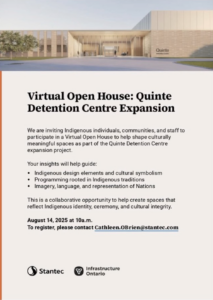
At first glance, initiatives like these appear responsive and sensitive to the TRC’s Call to Action 36, because, for Indigenous peoples who are currently incarcerated, even limited forms of cultural visibility — ceremony, language, familiar symbols — can matter profoundly. However, representation does not operate in a political vacuum. The expansion of the Quinte Detention Centre and other prison infrastructure projects like it, which colonial governments tout as examples of Indigenization, raises a more difficult and necessary question:
What does it mean to Indigenize a prison at the very moment governments across Canada are preparing to incarcerate more people?
The Prison as a Colonial Space
Scholars have long challenged the assumption that Indigenized prison reforms represent progress. Montford and Moore (2018) argue that the Canadian prison functions as a contemporary extension of the colonial reserve — a space organized through enclosure, surveillance, austerity, and racialized population management, and justified through the language of healing and cultural accommodation (pp. 640-642). In this framework, prisons are not neutral institutions that merely happen to confine Indigenous peoples; they are colonial spaces specifically calibrated to govern them.
This critique resonates strongly with Indigenous intellectual traditions that have long warned against the state’s appropriation of Indigenous spirituality and relational worldviews. Ojibwe Elder Art Solomon (1990), for instance, cautioned that Indigenous teachings are fundamentally incompatible with coercive institutional environments premised on domination, punishment, and control. For Solomon, healing cannot occur where autonomy, relational accountability, and spiritual freedom are structurally denied, which is why he worked alongside others to create Native Brotherhood and Native Sisterhood initiatives inside Canadian prisons that were run by Indigenous peoples themselves to reconnect them to “their cultures and lands with the autonomy to control their destinies” (Piché et al., 2019, p. 299). When Indigenous ceremonies are relocated into prisons and delivered by prison authorities, they may be stripped of their ethical, territorial, and relational foundations and repurposed to serve institutional ends, rather than community renewal or self-determination.
From this perspective, Indigenization runs the risk of not dismantling carceral power, but rather, reshaping it. Indigenous ceremonies, teachings, and cultural symbols are integrated into prison life, but only in ways that align with institutional objectives. The result is the production of what Montford and Moore (2018) describe as an “official Indigeneity,” a state-defined Indigenous identity that is legible, governable, and measurable within regimes of incarceration (pp. 653-654). Chartrand (2018) similarly demonstrates how Indigenous identity is selectively recognized within prisons in ways that reproduce racialized governance, while obscuring the structural violence of incarceration itself.
Ewert (2022) grounds this critique in lived experience, demonstrating how “correctional” institutions systematically misrepresent Indigenous histories, worldviews, and social realities through actuarial assessments and institutional decision-making processes. Drawing on his own experiences of being classified and managed through culturally invalid risk tools, Ewert shows how prisons operate as epistemic colonial spaces — sites that translate Indigenous difference into indicators of risk, deficit, and oppressive intervention. Even when these tools are legally challenged, the underlying authority of the prison to define, measure, and govern Indigenous identity remains largely intact.
Criminological scholarship further illustrates how this process functions as a technology of governance. Woolford and Gacek (2016) argue that contemporary penal institutions incorporate cultural recognition not as a challenge to colonial authority, but as a means of stabilizing it, allowing prisons to present themselves as responsive and progressive, while leaving their foundational logics intact. Martel and Brassard (2008) likewise show how rehabilitative discourses transform compliance into moral worth, recasting participation in institutional programming as evidence of personal reform rather than mere survival under coercive conditions.
Within this framework, ceremony becomes evidence of responsibilization and healing is operationalized as risk management.
Mussell (2020) extends this critique by demonstrating how Indigenous prisoners are positioned as simultaneously culturally deficient and in need of correction, with incarceration framed as a solution to intergenerational harm, rather than a source of it. Within this logic, Indigeneity becomes something to be managed and reshaped through carceral intervention, as prisons present themselves as sites of healing while reproducing colonial forms of control. What appears as reconciliation thus risks functioning as an extension of colonial governance, in which Indigenous identity is recognized only insofar as it aligns with institutional definitions of rehabilitation, rather than as expressions of sovereignty, law, or self-determination.
Taken together, these Indigenous and criminological critiques highlight that Indigenization — as practiced within prisons — is captured, no longer interrupting colonial power, but modernizing it. By translating Indigenous ways of knowing into administratively legible practices, the prison maintains its legitimacy as a site of control, while obscuring its ongoing role in the management of Indigenous life under settler colonialism.
Incarceration as Colonial Continuity
This dynamic is not new. Incarceration has been a core technology of settler colonialism in Canada prior to and since Confederation, operating alongside reserves, residential schools, and child apprehension systems as mechanisms of territorial control and population management (Nichols, 2014). Prisons are not simply institutions that disproportionately confine Indigenous peoples. They are political instruments through which colonial authority is asserted and maintained.
Indigenous peoples have experienced imprisonment continuously since the formation of Canada, often under conditions of heightened surveillance, segregation, and coercive rehabilitation (Nichols, 2014). For many Indigenous communities, prisons have come to function as violent spaces justified through paternalistic claims of reform, care, and protection while reproducing isolation, discipline, and the erosion of Indigenous self-determination.
This continuity matters. Framing Indigenous incarceration as a problem of “overrepresentation” risks obscuring the political nature of carceral power itself. As Nichols (2014) notes, this language treats imprisonment as an unfortunate outcome affecting racialized populations, rather than as a deliberate strategy embedded in settler state formation. It shifts attention away from the prison as a site of ongoing colonial governance and toward technocratic solutions that leave the structure intact.
When situated within this longer history, contemporary prison expansion cannot be understood as a neutral response to criminalized acts, nor can Indigenized reform be read as a meaningful departure from colonial practice.
Prison expansion is a political choice, one that extends a longstanding colonial infrastructure under new legitimating narratives.
Consultation as Containment
The Indigenous-focused open house for the Quinte expansion, held on August 14, 2025, illustrates how the Indigenization of prison infrastructure appears conciliatory while reproducing colonial power in practice. Indigenous participants were invited to share knowledge related to design, symbolism, programming, and culturally significant plants for the expanded women’s units, with engagement framed as collaborative and participatory. The resulting What We Heard report records feedback calling for Indigenous artwork, ceremonial programming, traditional medicines, and decarceration through diversion and community-based support (Infrastructure Ontario & Stantec, 2026). However, while these perspectives were formally acknowledged, they were ultimately subordinated to institutional priorities.
Calls for decarceration were categorized as “out of scope” for the project (Infrastructure Ontario & Stantec, 2026, p. 3). Many proposed medicinal plants were excluded on the basis of Crime Prevention Through Environmental Design (CPTED) criteria — a security-oriented planning framework that prioritizes surveillance, visibility, and risk management in the built environment — related to obscuring visibility, as well as plant density, toxicity, or other perceived security risks (Infrastructure Ontario & Stantec, 2026, p. 7). Other forms of cultural inclusion, including artwork and programming, were deferred to later stages of the project, leaving decisions about interpretation and implementation entirely with provincial jail authorities. In this way, Indigenous knowledge was solicited but filtered through carceral logics that preserve institutional authority.
This pattern of engagement, as documented in the What We Heard report, is instructive. Indigenous communities are invited to contribute cultural knowledge, yet they do not retain access to, ownership over, or control of what that knowledge becomes.
Consultation functions as a one-directional process: insight flows inward to the institution, while interpretation, selection, and decision-making authority remain exclusively with the state.
It is what Mathiesen (2006, p. 45) calls “absorption” whereby prison authorities incorporate ideas that challenge existing structures “in a way which subtly and imperceptibly changes the new element in it, so that in practice it fits into the prevailing structure without threatening it,” while giving the “impression of having introduced something new which breaks with the previous tradition.” In other words, participation is permitted, yet transformative critiques and practices are selectively incorporated or displaced, allowing prison expansion to proceed uninterrupted.
This is not a failure of individual intent. It is a feature of recognition-based governance, which, as Coulthard (2014) notes, often presents as progress while maintaining the core structures of colonial authority. Participation is visible, but outcomes are opaque. Indigenous knowledge is welcomed, but only on terms defined and managed by the institution itself. In a carceral context, consultation risks becoming another mechanism of administrative containment that absorbs Indigenous perspectives and knowledge without redistributing power.
Preparing for Incarceration
The political timing of the expansion of the Quinte Detention Centre is critical.
Across Canada, governments are signalling a renewed commitment to so-called tough-on-crime policies, including expanded police powers, less access to bail, and longer sentences (Department of Justice, 2025). These policies are not neutral. Indigenous peoples are already disproportionately policed, arrested, charged, tried, convicted and incarcerated (Chartrand, 2019; Statistics Canada, 2026), a pattern rooted in colonial dispossession and ongoing structural inequality. A renewed commitment to populist punitiveness will predictably intensify this pattern.
Government oversight and statistical reporting consistently document that punitive, ‘tough-on-crime’ approaches are associated not only with increased incarceration, but also with worsening conditions in custody and higher rates of death among Indigenous prisoners (Correctional Services Canada, 2023; Office of the Correctional Investigator, 2023; Public Safety Canada, 2024). Against this backdrop, the expansion of women’s units at the Quinte Detention Centre appears less like reconciliation and more like laying the groundwork for further entrenching settler colonialism.
Infrastructure is being built not to reduce incarceration, but to manage its anticipated growth.
Indigenization, in this context, is arguably functioning as a moral buffer that softens the appearance of expansion, while leaving its underlying logic intact. The prison is made more culturally legible even as it expands its capacity to confine.
Beyond Symbolic Inclusion
Indigenous cultural representation and programming inside prisons may offer moments of dignity, connection, and survival for those currently confined (Tetrault, 2022). That reality should be acknowledged. But it cannot be allowed to obscure the broader political function of Indigenization within the expanding Canadian penal state.
When cultural inclusion is used to legitimize incarceration, it risks normalizing confinement, rather than challenging it. When consultation occurs without transparency or shared authority, it reproduces colonial relations under the language of collaboration. And when prisons are expanded in the name of reconciliation, the violence of incarceration is reframed as care and healing.
Decolonization cannot occur within institutions designed to preserve settler sovereignty. Without confronting the expansion of incarceration itself, culturally infused reforms are not pathways to justice, but become techniques of legitimation, making the prison more palatable while leaving its colonial foundations firmly intact.
This is the tension at the heart of the expansion of the Quinte Detention Centre. It is not a question of intent or symbolism alone. It is a question of power, history, and futures being built, quite literally, through new prison spaces.
Table 1.
Overview of Completed Prison Infrastructure Projects Across Canada – 2020 to present (as of February 2026)
Acknowledgements
Thank you to Dr. Jon Frauley and Dr. Kanatase Horn in the Department of Criminology at the University of Ottawa for their intellectual contributions that shaped this piece.
Endnotes
See PDF Version for full references.