THE 23RD FIFA (Fédération Internationale de Football Association) Men’s World Cup kicked off on June 11th in Mexico City. The nearly 40-day tournament is being hosted by 16 cities across Turtle Island, including Toronto and Vancouver.
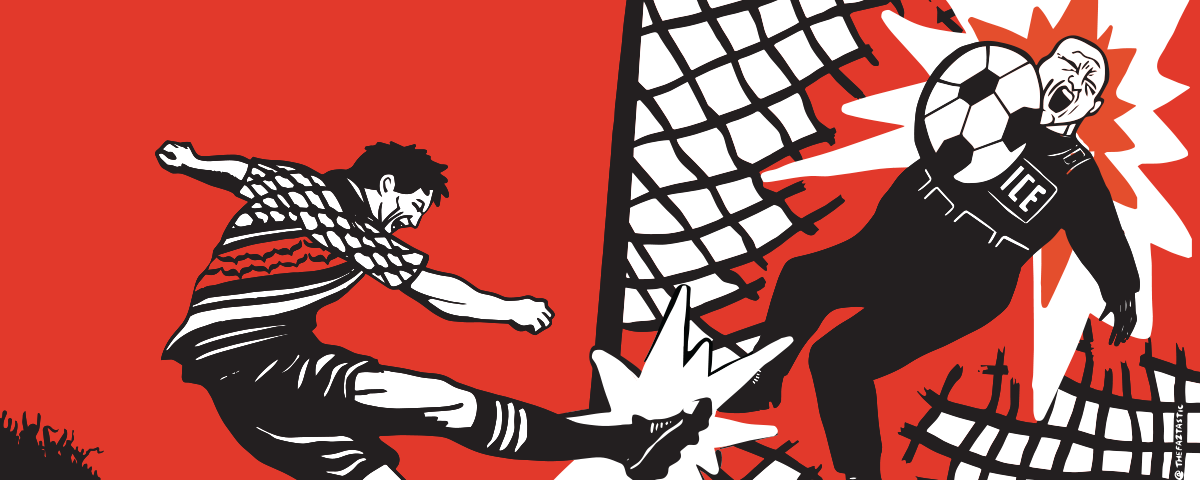
The tournament’s arrival is being celebrated as a moment of global attention and intra-national pride across the three nations. Yet, beneath the banner of “United as One” lie entrenched colonial logics and practices.
Whether it’s concrete harms advanced on Indigenous lands to secure the 2026 tournament stadiums, or the lack of institutional reckoning with football’s ongoing legacy of systemic racism, corruption, and colonialism, we cannot ignore that football has always been a deeply political terrain.
Still, while there are countless critiques to make of FIFA and elite sport more generally, we ask: can football be a tool for decolonization and social change?
A Global Celebration, Paid for by Local Communities
FIFA reported that more than half of the world’s population engaged with the 2022 FIFA Men’s World Cup across all media platforms, including linear television, digital channels, social media, and FIFA-owned platforms. The final match alone attracted an estimated global audience of 1.42 billion viewers. These figures help explain why Canada chose to spend approximately $1 billion on hosting just 13 of the 104 matches. The sheer size and impact of the World Cup make it synonymous with cultural impact and supposed economic benefits for local businesses (though the true extent of these impacts has also been debated). However, getting host cities “game-ready” often requires the most marginalized to bear the brunt of this development.
For example, in Vancouver, there were measurable impacts on Indigenous access to health care, even before World Cup matches began.
Regional health authorities, such as the First Nations Health Authority, which supports more than 200 First Nations in B.C., note that flights and accommodations may be limited or unavailable, even for urgent medical travel. Community leaders warn that rising transport and accommodation costs have forced many First Nations patients to postpone non-urgent medical travel. For communities already navigating systemic health inequities and vast geographic distances between reserves and medical services, postponing care has cascading health consequences.
Beyond healthcare inequities, marginalized communities bear the cost of high-profile events like the World Cup from the routine patterns of securitization that include increased surveillance, crowd-control measures, and joint law-enforcement operations — measures that disproportionately affect Indigenous, Black, and migrant populations, further deepening existing social inequalities.
Other host communities have also felt the strain of this massive tournament on their vital resources. For instance, in Mexico City, local reporters have argued that the intense influx of tourists has led to many rental units being converted into pricey temporary rentals — an incredible strain on the already dire housing market. As the advocates warn: “Every unit of scarcity becomes a unit of rent inflation, and the inflation does not reverse when the tournament ends — because the landlords who converted for the World Cup will have discovered what their property is worth to the global market.”
Locals in Mexico City have also sounded the alarm over the water supply, which already experiences regular outages, and residents say it will be further threatened by stadium expansion, which will increase demand.
It is worth noting the climate impact of the 2026 Men’s World Cup, which is projected to generate greenhouse gas emissions equivalent to a small country’s annual carbon footprint — and as we already know, Indigenous people are almost always the “first to face the direct consequences of climate change.”
And to be clear, these World Cup-induced harms are not new. Ten years after Brazil hosted the 2014 World Cup, the stadiums built for the tournament became underused, expensive to maintain, and a financial burden on communities that bore infrastructure costs while reaping little benefit. We have always known who really pays for these spectacles of sport.
Colonial Logics at Play
While the disregard for those who most acutely rely on the lands where the World Cup is held is awful, it is not, unfortunately, surprising — colonial legacy and logic are embedded through all elite global football.
In the Premier League, the world’s most popular football league, over 70% of players come from countries outside England — a significant number from South America, Africa, and Western Asia. In the World Cup, too, the top-contending nations are overwhelmingly European countries with deep colonial legacies that have subsequently had the means to both build up their national football infrastructure and attract talent from their former colonies: players who may hold dual citizenship or connections to other countries through their parents and grandparents.
While playing for these European nations often provides superior pay and professional development, there is a clear expectation for these players to adhere to white, Eurocentric expectations of respectability; otherwise, they will be punished. Mesut Özil, a German-born son of Turkish immigrants, captured this contradiction, saying, “I am German when we win, but I am an immigrant when we lose.”
Beyond the World Cup: Football for Liberation
While many have called for a boycott of the World Cup to pressure FIFA to change its destructive practices, it has so far proven difficult to mount large-scale action.
Anna Olimpia de Moura Leite, a PhD student at The New School for Social Research and a Director at LCA Consultores in Brazil, writes about why organizing on this issue is so hard, saying,
A true boycott is impossible because of the very people who keep the game’s heart beating. The World Cup is kept alive by the kids in the favelas, the immigrants in Queens, and the families in local bars who refuse to let their sport be stolen.
This is perhaps the heart of the issue: football itself — the game played in streets, on rooftops, in parks, and in community centers — belongs to people, but football is also a business, and FIFA, supported by countries and corporations seeking to get in on that business, have hijacked the people’s sport in the interests of capital.
Yet, this irony is not inevitable. Globally, countless examples demonstrate how football is a site of struggle, healing, and resistance.
Take in Gaza and the West Bank, amidst Genocide and Athleticide, football operates as a survival mechanism and a form of resistance to settler colonialism and genocide. Palestinian writer and journalist, Mohammed R. Mhawish, describes this survival mechanism: “As long as there is football, there is some hope that somehow, someday, ordinary life might be possible again.”
Here, football is not a spectacle managed from above; it is a practice of care, resistance, and collective imagining of a different future.
Further proving that football need not be beholden to the colonialist and capitalist logics of recent years, alternative football structures have emerged outside the World Cup’s official channels.
The CONIFA World Cup, for instance, brings together teams from unrecognized and partially recognized nations and territories, as well as refugees and Indigenous nations, to build solidarity through football. This tournament operates outside FIFA’s hierarchies and represents a radically different vision of what global football could be: one organized around marginalized communities’ own visions of belonging and nationhood.
Similarly, across North America, Left Wing Football Club (L.W.F.C.) and other grassroots groups have created spaces where football is explicitly decoupled from the vision and ideals currently present at the World Cup. Reporter Max Ross writes:
L.W.F.C. ‘s intent is to facilitate an inclusive version of the game, for all ages and skill levels, neither corrupted by FIFA’s corporate and consumerist politics nor tainted by the aggression inherent in sporting competition. The intent, in other words, is to bestow upon the game a carefree and democratic ethos.
Indigenous Football as a Decolonial Practice
Detailing how Indigenous people specifically have taken up football as a mechanism of decolonization and intergenerational healing, Lummi footballer and scholar Temryss MacLean Lane explicitly situates Indigenous football within a broader project of resistance to colonialism. She argues, “Indigenous soccer [football] operates as a mechanism of decolonization and re-membering for Indigenous Peoples who inherit colonial traumas.”
Lane’s work draws from Indigenous voices to articulate Indigenous football and Indigenous football identities within the framework of Sche’lang’en (shuh-lang-un). Sche’lang’en is a Lummi1 concept that roughly translates to “way of life” but encompasses far more: an integrated philosophy of existence that encompasses kinship systems, values, land relationships, and collective survival. Lane argues that when Indigenous communities play football, they do so not as adherents to a colonial sport, but as practitioners of Sche’lang’en. They embed the game within Indigenous worldviews and use it as a vehicle for cultural continuity.
So while we should be critical of how sports, especially football, have functioned as colonial technologies of assimilation, violent gendering, labour, and militarism, we should also remember that many marginalized people across the globe have long relied on football as a tool for liberation, a fact we can easily forget in the spectacle of the World Cup and in an environment where the story of Indigenous football has remained largely invisible.
Centring Indigenous football stories in sports culture can advance the goal of making Indigenous football locally accessible as an instrument of decolonial healing for generations of Indigenous Peoples — something more impactful than FIFA’s billion-dollar tournaments could ever hope to be.
Endnotes
- The Lummi, or Lhaq’temish, are a Coast Salish nation and the original inhabitants of the northernmost coast in Washington and southern British Columbia.