LATE LAST MONTH, the CBC exposed a Royal Canadian Mounted Police (RCMP) operation they called the “Native Extremism Program” designed to infiltrate and surveil Indigenous leaders and activists beginning in the late 1960s and into the 1970s.1
According to CBC’s research, “Hundreds of Indigenous people and at least 30 legitimate political organizations were monitored.” Canadian state officials were found to have used a wide variety of tactics to perform this surveillance, ranging from wire-taps to undercover informants, photography, and reviewing Indigenous people’s private records held by other government agencies.
After breaking online, I saw dozens of posts expressing shock and outrage. People, rightfully, were abhorred by the blatant racial profiling, breaches of privacy, and violations of rights of expression and dissent. And while we should be outraged by these uncoverings, we should not necessarily be shocked.
As many Indigenous people well know, racialized state-surveillance is not a phenomenon relegated to the 1970s; it is a well-practiced tradition dating back to the earliest days of Canada, and continues into the present.
And just as the practice of surveillance is not in the past tense, neither are its psychological impacts. As CBC details in their investigation, “For some Indigenous leaders, the era left a persistent legacy of paranoia. It manifests in suspicion. Wariness of new people. A check under the bed when travelling. Others had no clue they were being watched.”
How can we understand this persistent colonial practice of surveilling Indigenous peoples, and what action, if any, could help repair the generational damage that has been caused to Indigenous nations?
The Settler-State’s Shifting Justifications
While the “Native Extremism Program” of the 1970s justified its surveillance efforts by painting instances of Indigenous and Black organizing as radical and dangerous, Canada has taken up a much broader scope of reasons to try to justify its invasive actions over the years. This is natural in colonial or settler colonial contexts. Canada is, after all, invested in the permanence of settler colonialism — it is a settler state.
Perhaps you will remember the story from 2015 to 2016, where Dr. Cindy Blackstock, the Executive Director of the First Nations Child and Family Caring Society (FNCFCS), was awarded $20,000 by the Canadian Human Rights Tribunal (CHRT) for the federal government’s years of illegal surveillance for her work advocating for Indigenous children in court.2
According to APTN reports, Dr. Blackstock’s movements were monitored by Indian Affairs for nearly four years. Documents related to her case “show 189 federal servants were involved during that period, which also included officials from the Justice Department.”3 She testified that, in addition to other actions, Canadian officials monitored her social media and personal movements as part of efforts to get her to back down from a court case she was spearheading on behalf of Indigenous children in care — a case that, if won, would force the federal government to pay millions to case claimants.
Obviously, there is no basis for the federal government to argue that their surveillance efforts were based on fear of so-called extremist organizing — and the CHRT agreed.
Meanwhile, those engaged in defending the land have also been targeted. Scholar Andrew Crosby found that state intelligence agencies, including the RCMP and its Aboriginal Joint Intelligence Group, had created reports from as early as 2009 that “identified 18 Indigenous ‘communities of concern’ that the RCMP considered ‘highly volatile’ in that they ‘display existing tensions and conflicts’ that could impact nearby critical infrastructure.”4
Elsewhere, Crosby and co-author Jeffery Monaghan write that through freedom of information requests, they have established “police and security agencies, departments, and industry ‘partners’ [are] circulating volumes of personal information [about Indigenous people] in police data banks indefinitely,”5 often for similar reasons of monitoring potential threats to industry ventures.
Related, the much-critiqued6 Community-Industry Response Group (C-IRG) was formed in British Columbia in 2017 and “has no defined territorial jurisdiction, an unknown number of members, and no set budget,”7 all with a simple purpose: to intervene in locations where industry meets land occupations, blockades, and civil disobedience.
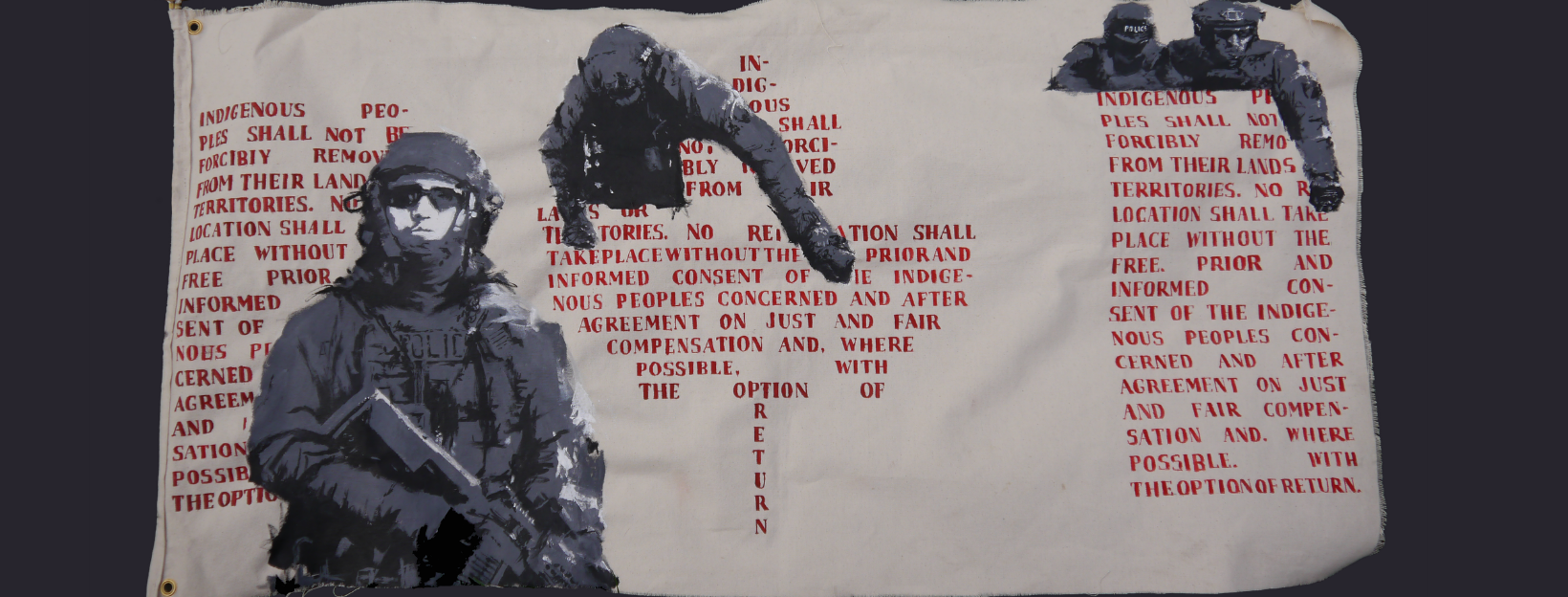
Using the legitimacy of the RCMP and seemingly unlimited resources to enact its mandate, C-IRG, which has since been renamed to the Critical Response Unit BC (CRU-BC), has arrested numerous land and water defenders, dragged dozens of Indigenous people off of their territories, and generally done whatever was necessary to make sure these state-backed industry projects go ahead without too much inconvenience.
In short, no matter the reason, Canada is constantly surveilling Indigenous people. In reality, however, Indigenous people know that the core reason is always this:
Indigenous people’s continued existence and insistence on living in accordance with our own laws and obligations poses a threat to settler-state legitimacy. Canada has recognized this threat Indigenous people pose from its earliest days, and tactics of surveillance and control have long been among the go-to means of mitigating it.
For instance, think of how Canada strictly limited Indigenous peoples’ access to exercise organizing practices under the Indian Act and earlier. Interventionist mechanisms, such as Indian agents, were introduced to Indigenous communities so Canada could keep track of all registered members of a community, monitor the movement of people and goods in and out of the community’s borders, and flag any suspicious activities for documentation.8
Indian agents acted as on-the-ground surveyors as well as deterrents to behaviours Canada did not want Indigenous people to practice. Those behaviours certainly included anti-colonial resistance efforts, but even our daily ways of living were threatening to Canada. After all, to gather, speak our languages, or orally share information was to continually assert that there were other ways to live beyond that prescribed by Euro-Canadian society.
While this is an example of a more explicit means of surveillance than the undercover operations undertaken in the 1970s or the rebranded efforts of the present day, these Indian agents produced the same result: keeping constant tabs on the perceived threat that Indigenous peoples presented to Canada.
Ongoing Impacts
As already mentioned, the psycho-social impacts of these generations of surveillance are profound. It can become difficult to trust others (a key to mobilizing divide-and-conquer tactics) or to get through your day-to-day without paranoia. Moreover, the knowledge that surveillance is so pervasive may deter people from exercising their rights to organize, protest, and express dissent.
More than that, however, the considerable resources that Canada continually invests in these surveillance and oversight efforts stand in contrast to its purported reconciliatory priorities of investing in Indigenous Nations and repairing harm.
While we may not know the exact amount spent on these surveillance activities, we can safely assume that the total is in the hundreds of millions. CRU-BC alone spent over $50 million in the first five years of its operations.9
These amounts stand out starkly against recent budget cuts to Indigenous services,10 which limit the already grossly insufficient funding standards Indigenous people have been pointing out for generations, and make all unfulfilled funding commitments feel especially pointed.
Canada seemingly has an infinite budget when it comes to surveilling Indigenous bodies, but still cannot find the means to provide basic rights to countless communities or pay their court-mandated reparations in a timely manner.
Moreover, given this extensive practice of surveillance, you would think that Canada would have the infrastructure and practice to meet Indigenous demands for data collection. For instance, there are eight data-specific Calls for Justice in the Final Report of the National Inquiry into Missing and Murdered Indigenous Women and Girls, including a call for the creation of a national database on reports of missing individuals.11 So far, only moderate progress has been made on meeting these calls, according to the latest update from the Assembly of First Nations (AFN).12
Data to criminalize Indigenous people is good. Data to improve the lives of Indigenous people is non-essential.
Canada’s lack of action regarding Indigenous issues is not due to any actual practical concerns, but rather a deliberate lack of will.
Real Reparations?
Only a day after the CBC story made headlines, the RCMP Commissioner issued an official statement of regret.13 In this statement, Commissioner Mike Duheme insisted that “The RCMP today is not the same organization it was decades ago,”14 but, as this Brief shows, that claim is not true in many integral ways.
This leads us to the real question: what, if anything, can be done to appropriately address the ongoing legacy of harm caused by state surveillance?
The answer certainly begins with first recognizing that surveillance efforts are ongoing. Even today, we don’t know the full scope of how Canada has, and continues to, surveil Indigenous people — and this will be difficult to find out so long as Canada continues to delay responses to Access to Information Requests and fight the release of records in court.15 If we knew the true extent of Canada’s surveillance measures, surely we could provide a more meaningful list of actions to take.
But even with the knowledge we have, we can begin to envision different ways forward. Some may argue that we should interrogate or impose consequences on the key decision-makers who approved and oversaw surveillance operations. If surveilled individuals are still alive and living with the repercussions of these projects, then it stands to reason that so too should the perpetrators of these harms. Perhaps a process for individuals to claim monetary reparations — similar to those Dr. Blackstock was awarded — for the years of psycho-social harms experienced as a result of these actions, would also be appropriate. And as always, there is a whole host of reformist recommendations that could be put forward for Canada’s policing and intelligence bodies to grapple with.
However, is true repair an option in this context?
After all, the threat Indigenous people pose to Canada’s legitimacy hasn’t waned — if anything, I might argue that more Indigenous people than ever regularly question Canada’s authority and are seeking alternatives to the settler-colonial status quo. If this is true, then we should expect that Canada will continue to keep watch over Indigenous people.
In this case, the question is not “How can Canada repair this harm?” but “How can we, Indigenous people committed to building worlds beyond Canada, best contend with the realities of Canadian surveillance”?
How can we address the psychological impacts we know arise from surveillance? How can we organize our movements to be as resilient as possible against these tactics?
In all, while the latest CBC story is an important act of investigative journalism and its findings should outrage us, it should also remind us that state-backed surveillance of Indigenous people is not an anomaly; it is the norm.
We can try to pressure Canada to reckon with this norm, or we can find ways to build in spite of it.
Endnotes
1 Based on analysis of their departmental results reports.
2 Directions Letter, “Cindy Blackstock awarded $20,000 in human rights ruling against Harper Government,” UFCW Canada, June 20, 2015, https://www.ufcw.ca/index.php?option=com_content&view=article&id=30618:cindy-blackstock-awarded-20-000-in-human-rights-ruling-against-harper-government&catid=9634&Itemid=98&lang=en.
3 Nation to Nation, “Recording a telephone call? 189 federal servants spied on Cindy Blackstock under Wernick and Justice department,” APTN News, April 4, 2019, https://www.aptnnews.ca/national-news/recording-a-telephone-call-189-federal-servants-spied-on-cindy-blackstock-under-wernick-and-justice-department/.
4 Andrew Crosby, “The racialized logics of settler colonial policing: Indigenous ‘communities of concern’and critical infrastructure in Canada,” Settler Colonial Studies 11, no. 4 (2021): 412.
5 Andrew Crosby and Jeffrey Monaghan, Policing Indigenous Movements: Dissent and the Security state (Fernwood Publishing, 2018), 3.
6 “Abolish C-IRG Open Letter” Abolish C-IRG, accessed April 8, 2026, https://abolishcirg.org/.
7 Brett Forester, “RCMP has spent nearly $50M on policing pipeline, logging standoffs in B.C.,” CBC News, January 6, 2023, https://www.cbc.ca/news/indigenous/rcmp-cirg-spending-resource-extraction-1.6705076.
8 John L. Steckley, Indian Agents: Rulers of the Reserves (Peter Lang Publishing, Inc., 2016).
9 Brett Forester, “RCMP has spent nearly $50M on policing pipeline, logging standoffs in B.C.”
10 https://yellowheadinstitute.org/2025/budget-2025-a-new-era-in-indigenous-canada-relations/
11 National Inquiry into Missing and Murdered Indigenous Women and Girls, Reclaiming Power and Place: the Final Report (2019), https://www.mmiwg-ffada.ca/final-report/.
12 Assembly of First Nations (AFN), Progress On Breathing Life into the Calls for Justice – A CFJ Progress Report, (AFN, 2019), 53.
13 Olivia Stefanovich and Brett Forester, “RCMP commissioner regrets Indigenous spying program that spanned over a decade,” CBC News, March 27, 2026, https://www.cbc.ca/news/politics/rcmp-response-indigenous-spying-operation-9.7141533.
14 Olivia Stefanovich and Brett Forester, “RCMP commissioner regrets Indigenous spying program that spanned over a decade.”