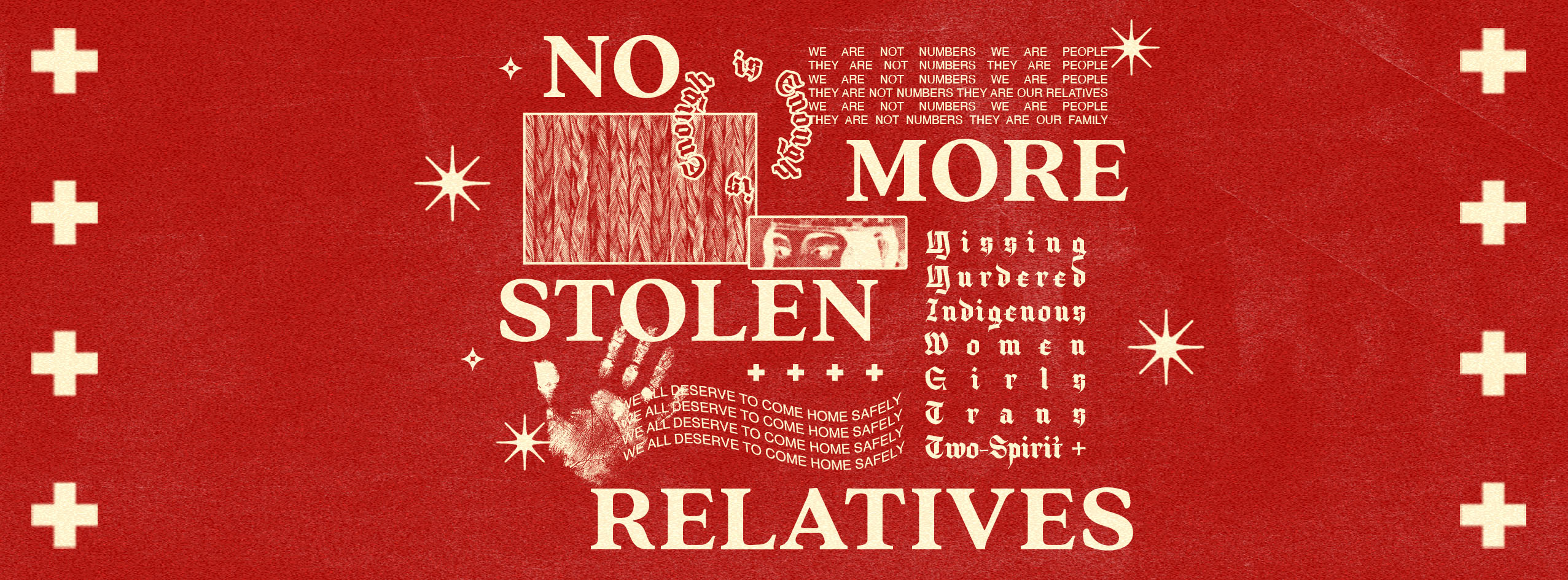
In April 2026, Indigenous women’s groups announced looming funding cuts for Missing and Murdered Indigenous Women and Girls (MMIWG+) support. These cuts occurred without transparent communication or forewarning. At the press conference, Hilda Anderson-Pryz stated, “in March, crucial funding to some Indigenous organizations ended with no official notification of renewal… This lack of sustained support is a significant barrier to making real progress and combating this crisis. Today, our right to life is threatened by the lack of political will and it will remain so until the government enacts the 231 calls for justice. But seven years later… only two have been fully implemented.” Anderson-Pryz addresses the heart of the matter – the true cost of funding cuts – Indigenous women’s lives.
This economic austerity measure is known as the “sunsetting” of funding. In this case, the federal government will allow critical funding to expire without renewal.
Contrary to the National Inquiry’s (2019) Calls for Justice, which outline the need for long-term, guaranteed, and sustainable funding, multiple programs and projects involving “Indigenous rights, title, and gender-based violence prevention and response” are on the chopping block (Macdonald & McIntosh, 2025). These cutbacks demonstrate that the lives of Indigenous women do not matter to Canada.
In response to the press conference, over 400 family members of MMIWG+ have questioned the efficacy of National Indigenous women’s organizations. In a letter to Federal government officials, they note that “these organizations do not represent the families” (Ward, 2026, para. 3). This distrust is indicative of tensions between families and Indigenous women’s groups. Both this letter from family members and the National Inquiry (2019) emphasize the need to invest in and resource self-determined, family and survivor-led solutions.
In this period of economic austerity, and given Canada’s long history of gendered colonization, it is not a surprise that gender-based reconciliatory initiatives are considered expendable.
What do Trump and Carney Have in Common?
These austerity measures follow news south of the border, where the Trump administration is making funding cuts to the Office on Violence Against Women, which will disproportionately affect Indigenous women. In November 2025, as a part of its attack on diversity, equity, and inclusion, Trump’s administration removed a report from the Department of Justice on Missing and Murdered Indigenous Peoples. Another generation of Indigenous women, on both sides of colonially imposed borders, is now subject to, and targeted by, government policy and societal indifference.
Canada likes to position itself as superior to our Southern neighbours, perpetuating a master narrative of a peaceful, multicultural, accepting, and polite country (Thobani, 2007). This posturing obscures the ongoing colonial genocidal violence that Indigenous Peoples experience through state regimes, policies, and systems. Our relationship to the nation state has always been defined by violence, and hate against Indigenous women runs deep. Despite a master narrative that portrays Canada as a human rights beacon, Indigenous women’s human rights are continuously violated (Luoma, 2021; National Inquiry, 2019a).
Racism, heteropatriarchy, and misogyny have contributed to Indigenous women being targeted for violence (Bourgeois, 2018; National Inquiry, 2019). The “root cause of violence” against Indigenous women and girls is a “race-based genocide,” and gendered colonization that impacts our safety and contributes to increased violence (Duhamel, 2015; National Inquiry, 2019). Through framing MMIWG as an “Indigenous problem,” Canada has obscured its culpability for ongoing genocide (Bourgeois, 2015; Dowling, 2019; National Inquiry, 2019). The rise in residential school denialism, white nationalism, and general disdain for Indigenous Peoples continues apace, colliding with growing economic uncertainty and fear.
The Economics of Gender (In)Justice
Under “Canada Strong,” Prime Minister Mark Carney’s Federal government made massive budget cuts to “Indigenous Services Canada (ISC) and Crown-Indigenous Relations and Northern Affairs Canada (CIRNAC),” and to employees who work on the Indigenous rights and relations portfolio at the Department of Justice. These fiscal constraints will widen socio-economic gaps between Indigenous and non-Indigenous Peoples and contribute to the continued underfunding of essential human services. These cutbacks are not “neutral but in fact follow… racial [and, in this case, gendered] lines” (Levesque, 2025, para. 8).
Despite Human Rights Tribunal findings that the Canadian government has continuously discriminated against Indigenous children through underfunding child welfare services, these recent measures represent a continued colonial strategy of slashing funding and violating the rights of Indigenous Peoples. Notably, “the Canadian Human Rights Commission” is also slated to face funding cuts, which will surely exacerbate the impact of these austerity measures (Levesque, 2025; Smith, 2025, para. 11).
Amidst this uncertainty, Canada’s economic priorities reveal a shallow commitment to “reconciliation” (Assembly of First Nations, 2025) and gender justice, with disproportionate impacts for Indigenous women. Additionally, federal service cuts include Correctional Service Canada (CSC). Over 50% of federally incarcerated women are Indigenous (and have an MMIW family member). Given the importance of literacy levels for rehabilitation and reintegration, CSC’s proposed cuts to “library technicians and employment co-ordinator positions” will contribute to the ongoing confinement of Indigenous women (Ibrahim, 2026, para. 1), contrary to the Department of Justice’s Indigenous Justice Strategy (IJS) released in March 2025.
Implementing the IJS strategy will require “substantial effort and funding commitments” (Horn, 2025, para. 11). The 2025 Canada Strong Budget does not mention the IJS. Just like the clip art adorning the IJS – this is yet another example of window dressing – the shifts, niceties, and apologies that momentarily give us hope, “only to ultimately crush it” (Horn, 2025, para. 13).
Together, these economic measures confirm that the era of rights and reconciliation for Indigenous Peoples, and Indigenous women in particular, is long gone. Instead, as the budget reveals, our inherent rights, laws, and lives are overridden in pursuit of military, extractive, and industrial projects, so-called economic reconciliation or, the “National Interest.”
Economic reconciliation maintains dependence on a predatory economy and perpetuates violence against the land, waters, and Indigenous women. It is not freedom. It is not self-determination. It is colonization.
Clearly, the lives, human rights, and safety of Indigenous women are not a priority for the Federal government. These austerity measures coincide with record-breaking military spending. As NDP Member of Parliament Leah Gazan noted, Prime Minister Carney is cutting approximately “$7 billion of funding between ISC and Crown-Indigenous relations… and has recently committed $13 billion in military funding.” Funding constraints continue amidst increasing rates of violence against Indigenous women, and minimal effort to implement the National Inquiry’s calls for justice.
Violence on Violence
Indigenous women have long identified the solutions, programs, and support needed to respond to and protect them from violence. Those solutions have been consistently ignored by successive colonial governments (Aboriginal Justice Inquiry of Manitoba, 1991; Amnesty International 2004; National Inquiry, 2019; Royal Commission on Aboriginal Peoples, 1996). Families have continuously questioned decisions that are made without them, behind closed doors.
This lack of transparency and accountability continues with the Canada Strong Budget (2025). Existing programming was already subject to patchwork – meaning it is often unsustainable, short-term, and project-based (or all three) – funding issues, and ongoing struggles to meet the needs of clientele (National Inquiry, 2019a).
Tightening the fiscal shoestrings and using stealthy “sunsetting” to halt funding that supports ending violence against Indigenous women – while simultaneously increasing funding to support the military industrial complex – demonstrates the Canadian government’s ongoing commitment to sustaining shape-shifting colonial violence.
Endnotes
Assembly of First Nations [AFN]. Federal Budget 2025. AFN, 2025. https://afn.ca/all-news/bulletins/federal-budget-2025/
Bourgeois, E. “Generations of genocide – The historical roots of missing and murdered Indigenous women and girls.” In K. Anderson, C. Belcourt, & M. Campbell (Eds.), Keetsahnak, Our Missing and Murdered Indigenous Sisters. University of Alberta Press, 2018.
Bourgeois, R. “Colonial exploitation: The Canadian state and the trafficking of Indigenous Women and Girls in Canada.” UCLA Law Review, 1426 (2015): 1428-1463.
CPAC. “Indigenous women’s groups warn of the sunsetting of some funding for MMIWG supports.” April 8, 2026 [Video]. YouTube. https://www.youtube.com/live/ak-r2G48WeA
Department of Justice Canada. Indigenous Justice Strategy. Government of Canada, 2025. https://www.justice.gc.ca/eng/csj-sjc/ijr-dja/ijs-sja/tijs-lsja/pdf/IJS_EN.pdf
Dowling, S. Elimination, in the feminine. Interventions: International Journal of Postcolonial Studies, 21.6 (2019): 787-802. https://doi.org/10.1080/1369801X.2019.1607525
Duhamel, K.R. “‘I feel like my spirit knows violence’ understanding genocide – and how to stop it – in the context of the National inquiry into missing and murdered Indigenous women and girls.” In J. Black-Morsette (Ed.), REDress. HighWater Press, 2025.
Fryer, S. & Leblanc-Laurendeau, O. Background paper: Understanding federal jurisdiction and First Nations (Publication No. 1019-51-E). Parliamentary Information and Research Service, 2019. https://lop.parl.ca/staticfiles/PublicWebsite/Home/ResearchPublications/BackgroundPapers/PDF/2019-51-E.pdf
Government of Canada. Canada Strong Budget 2025. Government of Canada, 2025. https://budget.canada.ca/2025/report-rapport/pdf/budget-2025.pdf
Horn, K. “The Indigenous Justice Strategy: ‘Progressive and Transformative Reform’?” Yellowhead Institute, May 21, 2025. https://yellowheadinstitute.org/2025/the-indigenous-justice-strategy-progressive-and-transformative-reform/
Hwang, P. “Cuts targeting Indigenous rights staff at Justice Department ‘reckless,’ critics warn.” CBC News. February 23, 2026. https://www.cbc.ca/news/canada/ottawa/cuts-targeting-indigenous-rights-staff-at-justice-department-reckless-critics-warn-9.7097164
Ibrahim, S. “Federal prisons to lose library technicians, employment co-ordinators in budget cuts.” CBC News. March 11, 2026. https://www.cbc.ca/news/politics/prison-cuts-librarians-employment-coordinators-9.7123434
Lapointe, J. “Can the new B.C. government bring real change for Indigenous communities?” The Narwhal. November 20, 2024. https://thenarwhal.ca/energy-economic-reconciliation-indigenous-youth-bc/
Levesque, A. “Carney government cuts unfairly hit First Nations.” Policy Options. July 22, 2025.https://policyoptions.irpp.org/2025/07/budget-cuts-first-nations/
Luetkemeyer, E. “Trump administration removes report on Missing and Murdered Native Americans, calling it DEI content.” Oklahoma Watch. November 14, 2025. https://oklahomawatch.org/2025/11/14/trump-administration-removes-report-on-missing-and-murdered-native-americans-calling-it-dei-content/
Luoma, C. “Closing the cultural rights gap in transitional justice: Developments from Canada’s National Inquiry into Missing and Murdered Indigenous Women and Girls.” Netherlands Quarterly of Human Rights, 39.1 (2021): 30-52. https://doi.org/10.1177/0924051921992747
Macdonald, D. & Mcintosh, E. ‘Budget cuts by stealth: Letting programs ‘sunset’ to cut costs won’t be painless.” Canadian Centre for Policy Alternatives. October 28, 2025. https://www.policyalternatives.ca/news-research/budget-cuts-by-stealth-letting-programs-sunset-to-cut-costs-wont-be-painless/
National Inquiry. (2019a). Reclaiming power and place: The final report of the National Inquiry Intro Missing and Murdered Indigenous Women and Girls. National Inquiry, 2019. https://www.mmiwg-ffada.ca/wp-content/uploads/2019/06/Final_Report_Vol_1a-1.pdf
Pember, M.A. “Trump administration targets office on violence against women with ‘consolidation.’” ICT News. January 29, 2026. https://ictnews.org/news/trump-administration-targets-office-on-violence-against-women-with-consolidation/
Smith, D. “‘Concerning’ cuts to justice system in federal budget.” CBA National. November 5, 2025. https://nationalmagazine.ca/fr-ca/articles/law/hot-topics-in-law/2025/%E2%80%98concerning-cuts-to-justice-system-in-federal-budget
Thobani, S. Exalted subjects: Studies in the making of race and nation in Canada. University of Toronto Press, 2007.