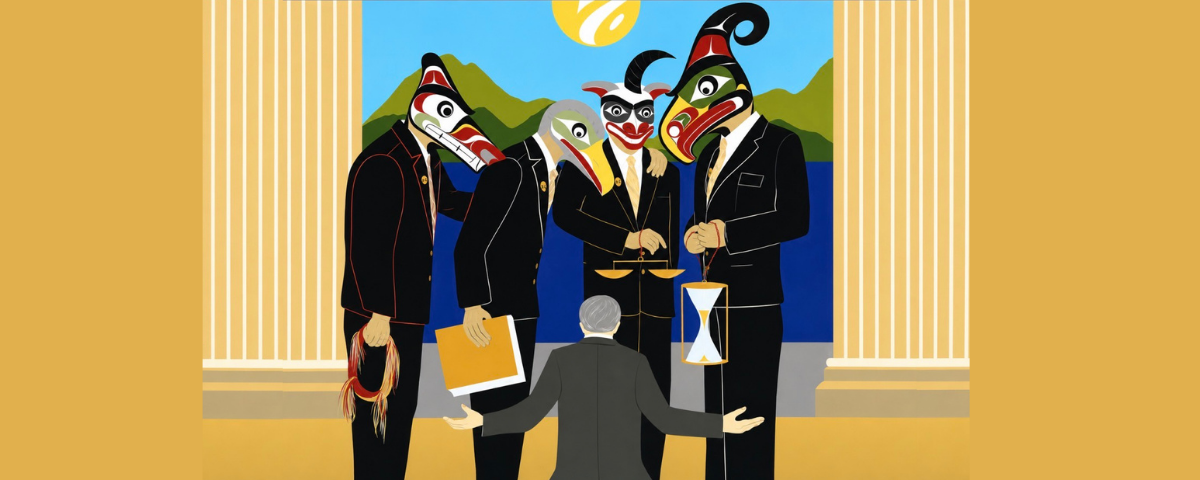
ABORIGINAL TITLE has recently become the subject of intense national attention—and has attracted widespread misconceptions. Following the decisions in Cowichan Tribes v Canada and Wolastoqey Nation v New Brunswick, public commentary has frequently portrayed Aboriginal title as an immediate threat to private homeowners. In British Columbia, this misconception has included misinformation that has bordered on the absurd, including fake letters purporting to be sent by Indigenous peoples ordering homeowners from their properties, municipal councillors claiming some residents can no longer get home-related insurance, and even the Wall Street Journal arguing the Cowichan Tribes case “threatens billions in real-estate investment.” This public debate often presents Indigenous peoples and private landowners as opposing parties competing for the same land. That framing obscures the role of the Crown, which is responsible for any conflict because it grants private property on lands subject to Aboriginal title.
In this Brief, we explain why neither of the decisions in Cowichan Tribes and Wolastoqey conclude that recognizing Aboriginal title entails displacing fee simple titles and, more fundamentally, these decisions turn our minds to pathways that do not require choosing between Aboriginal title and fee simple title. We also explain that despite these decisions leaving many issues unresolved and creating some practical uncertainty, bringing clarity to these issues cannot be achieved without recognizing that the Crown is ultimately responsible, because it grants fee simple title over lands subject to pre-existing and underlying Aboriginal title. Throughout Canada, there are many important questions about where these decisions might bring us and how the relationship between Aboriginal and fee simple can be clarified. We suggest that clarity, stability, and certainty come from looking to Indigenous legal orders for solutions.
Aboriginal Title and Fee Simple Private Property
Although fee simple (a type of common law land ownership) and Aboriginal title are both concerned with rights to the land, they remain distinct in various ways.
For instance, the sources of these rights are different. Aboriginal title is not a right granted by the Crown. It is a constitutionally protected interest in the land that arises from Indigenous peoples’ occupation and governance of their territories before the Crown asserted sovereignty. Section 35 of the Constitution Act, 1982 recognizes and affirms Aboriginal title, but it is not the source of that title. A court also does not create Aboriginal title when it issues a declaration, because that declaration simply legally confirms the right exists.
This distinction matters when lands are subject to both Aboriginal title and fee simple interests. Private property interests do not simply arise independently of the Crown. They are created through Crown grants and registered in provincial land-registration systems. Those same systems contribute to the continued denial of Aboriginal title, while the Crown itself actively denies or disregards its continuing existence.
The central legal problem is therefore a conflict not created by Indigenous peoples, but by the Crown.
Provincial private property regimes have not effectively considered pre-existing Aboriginal title rights—and this results in fee simple titles being granted over lands subject to Aboriginal title. Cowichan Tribes and Wolastoqey illustrate two judicial efforts to address that overlap, while demonstrating the limits of exclusively relying on Canadian law and courts.
The Cowichan Tribes and Wolastoqey Decisions
Cowichan Tribes v Canada is a case concerning whether the Cowichan Nation (comprising five First Nations bands) has Aboriginal title to a seasonal village that is known as Tl’uqtinus and located near the mouth of the Fraser River. The issues present were extensive, but the British Columbia Supreme Court ultimately recognized Cowichan Nation’s Aboriginal title over a portion of Tl’uqtinus lands held privately by the Crown and a municipal government. Contrary to claims that the decision invalidated third-party property rights, the Plaintiffs (collectively the Cowichan Nation) expressly limited the relief they sought:
“the plaintiffs seek a declaration that the fee simple titles held by Canada, the VFPA [Vancouver Fraser Port Authority] and Richmond are defective and invalid… They do not seek the same declaration in respect of privately-owned lands.”
In addition to this, the Court did not declare privately held lands invalid or interfere with the continued use and occupation by private property owners. The Court did, however, declare that the Cowichan Nation has Aboriginal title rights over lands that Canada and Richmond hold in fee simple. The Court ultimately decided that a portion of Canada and the City of Richmond’s lands held in fee simple are defective and invalid, because the originating Crown grants were made without the proper statutory and constitutional authority.
In reaching this conclusion, the Court rejected the proposition that provincial land grants had extinguished the underlying Aboriginal title.
Before the Constitution Act, 1982, extinguishment required the Crown’s “clear and plain” intention to extinguish Aboriginal rights (e.g. through legislative extinguishment). A province could not extinguish Aboriginal title because doing so would intrude upon Parliament’s jurisdiction over “Indians, and Lands reserved for the Indians.” As the Supreme Court stated in Delgamuukw (1997), “a provincial law could never, proprio vigore [of its own force], extinguish aboriginal rights.” Provincial fee simple grants and land title legislation therefore could not have, by themselves, extinguished Cowichan title.
Considering this, the question turns to the relationship between the two forms of title: Aboriginal title (which pre-dates, and was not extinguished by, exertion of Crown control over the land) and fee simple title (an interest in land created by the Crown and capable of being vested in private property owners).
Because the Plaintiffs did not seek to invalidate third-party private property, the Court kept its analysis of this relationship general. The Court decided that a declaration of Aboriginal title is not precluded by the existence of fee simple title over those same lands. A declaration of this kind need not displace fee simple rights but can result in legal coexistence between Aboriginal title and fee simple title. If such coexistence is recognized, the Court stated that “the exercise of one form of title must yield to the other…”
Coexistence was found in Cowichan Tribes, and because the Cowichan Nation did not challenge third-party private property, Justice Young held that the exercise of Cowichan Aboriginal title yields to private interests:
“[S]o long as the fee simple interests exist, the ability of the Cowichan to exercise the incidents of Aboriginal title are constrained to the extent they conflict with the rights of the private fee simple title holders.”
Where a court recognizes coexistence, such a recognition can be a catalyst for negotiated solutions between the Aboriginal title holders and the Crown.
The judgment, currently under appeal, thus recognized the coexistence of both Aboriginal title and private property interests and held that conflicts in the exercise of those coexisting interests results in a question of which one gives way to the other. Because the Cowichan Nation did not question those private interests, the Court protected private fee simple rights by limiting how Aboriginal title could be exercised where the two conflict.
Wolastoqey raised a different issue. This case is concerned with whether the Wolastoqey Nation (comprising six First Nations bands) has Aboriginal title rights over an expansive portion of western New Brunswick. The case, however, was not yet at the stage of the Plaintiffs needing to prove a right of Aboriginal title, but at the stage of deciding whether corporate private property owners added as defendants needed to remain parties to the claim. Ultimately, the Plaintiffs did not seek to invalidate the titles of private owners who were not parties, and they even characterized the corporate defendants as “innocents.”
At first instance, the Court of King’s Bench in New Brunswick held that the responsibility for addressing any conflict between Aboriginal title and private property rests with the Crown, not private parties. Because Aboriginal title is a constitutional and sui generis (unique) interest, the Court concluded that the corporate landowners need not participate in the proceeding because there is no direct legal link. In essence, the Court decided that “[a]ll roads lead to the Crown.”
On appeal, the New Brunswick Court of Appeal adopted a qualified approach. It held that a binding declaration of Aboriginal title over privately held land would generally require the affected owner to participate in the proceeding. Where private owners were absent, however, a court could still make findings of Aboriginal title, which do not confer ownership rights but are capable of supporting compensation or other relief against the Crown. The Court of Appeal also held that Aboriginal title and fee simple rights are fundamentally incompatible, such that the former, once declared, is unable to coexist with the latter.
On May 28, 2026, the Supreme Court of Canada denied leave to appeal, without reasons. The Court of Appeal’s decision therefore remains in force in New Brunswick, although the denial of leave does not indicate whether the Supreme Court agreed or disagreed with the Court of Appeal’s reasoning.
What Canadian Law Leaves Unresolved
Taken together, neither Cowichan Tribes nor Wolastoqey establish that recognizing Aboriginal title displaces private property rights. Despite this, both decisions offer different and incomplete responses to the intersection of Aboriginal title and fee simple interests where the Crown has granted fee simple interests over lands subject to pre-existing Aboriginal title.
The approach in Wolastoqey promotes judicial discretion in making declarations and findings of Aboriginal title. Where third parties do not participate in the proceeding, a court may only make findings of Aboriginal title, which do not confer ownership rights but can support “damages and compensation against the Crown.” This approach protects absent landowners and limits the remedies available to Indigenous peoples. Professor Emeritus Kent McNeil, who is a leading authority on Aboriginal title, argues that the Court mistakenly treated declarations of Aboriginal title as discretionary “bare declarations,” when, in fact, they are non-discretionary in nature (with consequential relief). The result of this mistaken understanding, Professor McNeil argues, is a decision that stands for courts exercising non-existent discretionary authority to not grant a declaration after making a positive finding of Aboriginal title.
In addition to this, the Court in Wolastoqey provided only a partial incompatibility analysis regarding shared rights from an operational perspective between Aboriginal title and fee simple interests, without fully considering Aboriginal title’s sui generis nature. For example, the Court did not consider rights of governance and jurisdiction that may flow from or are parasitic to Aboriginal title, which would not be shared rights with private property and therefore their legal coexistence could not be incompatible.
Nevertheless, both decisions are the result of a sole reliance on the principles of Canadian property and constitutional law and effectively ask how Aboriginal title can be molded around private interests created by the Crown. Neither decision asks how the relevant Indigenous legal order, or any alternative legal orders, would understand or govern the relationship between Aboriginal title and private property, nor what Indigenous legal remedies exist within those legal systems to manage issues such as these.
The Cowichan Tribes and Wolastoqey decisions demonstrate both what litigation can accomplish and what it leaves unresolved. Courts can confirm Aboriginal title, protect procedural rights, and assign liability to the Crown. But neither decision provides a complete framework for how Aboriginal title and existing fee simple interests are to operate alongside one another. That gap leaves legal and practical uncertainty that can be transformed through public debate into claims that recognizing Aboriginal title necessarily threatens private ownership. The problem is not that either court has displaced private property, but the many practical questions that remain following the release of these decisions about how these disparate systems can coexist.
Questions concerning continued possession, future transfers, land use, jurisdiction, compensation, and coordination between governments cannot be resolved through declarations or findings of title alone. They will require negotiation. And because the relationship between Aboriginal title and fee simple interests is not solely a question of Canadian property and constitutional law, those negotiations should not be governed by Canadian law alone. Indigenous legal orders are themselves sources of law and authority capable of determining how existing interests may be protected, regulated, compensated, or otherwise governed. The questions left unresolved by Cowichan Tribes and Wolastoqey therefore point toward negotiated solutions in which Indigenous legal orders form part of the law governing the relationship.
Looking Beyond Canadian Courts: Indigenous Legal Orders and Negotiated Solutions
Against the backdrop of Canadian property law, the framing of the relationship between Aboriginal title and fee simple interests tends to be founded upon the understanding that they are competing interests in the same land.
But Indigenous legal orders often begin with different questions: what relationships, responsibilities, and lawful arrangements should govern the people who now share a territory?
John Borrows, an Anishinaabe law scholar and leading authority on Aboriginal rights, rejects the zero-sum approach to the relationship between Aboriginal title and private property. In presenting Indigenous legal orders as sources to bring clarity to the relationship between Aboriginal title and private property, Professor Borrows observes that “most Indigenous peoples recognize that the dispossession of their non-Aboriginal neighbours would not be just, fair, honourable or in accord with their society’s own law and morality.”
While some may take issue with the language of “dispossession” applied to non-Indigenous private property owners, the sentiment is nonetheless relevant, as third-party private property holders were intentionally excluded from the claim in Cowichan Tribes and were excluded or described as innocents in Wolastoqey. As Professor Borrows explains, “private property’s relationship with Aboriginal title may be constitutionally protected through Aboriginal governance.”
This does not mean that Aboriginal title, in effect, becomes irrelevant over areas where fee simple interests have been conveyed. Rather, this means that Indigenous legal orders provide solutions that have yet to be contemplated by Canadian courts, and these solutions are not limited to choosing between Aboriginal title and fee simple title. For instance, private interests could instead be recognized, mediated, or transformed through Indigenous constitutional arrangements, legislation, land-management institutions, or dispute-resolution processes. At the same time, Indigenous legal orders could recognize Aboriginal title rights and governmental rights over lands that the Crown has conveyed privately.
There are limitless solutions within Indigenous legal orders that are innovative, practical, considerate, rigorous, and just. They can provide pathways to bring certainty, stability, and clarity to questions of possession, jurisdiction, land use, compensation, lawful transition, and relationships among those who share the land.
The need for Indigenous legal orders bringing clarity to Canadian law issues is growing. This became especially apparent recently in the British Columbia Court of Appeal in R v Dsta’hyl, which is a case concerned with whether Indigenous law can establish a novel common law defense. Although not related to Aboriginal title and private property, the decision in Dsta’hyl provides an important opening for the analysis of the role of Indigenous legal orders in Canada. The Court affirmed that “Canada has a multi-juridical tradition” and that, subject to limits articulated through Canadian law, “Indigenous legal orders operate alongside the Canadian common law.”
Chief Justice Marchand writing on behalf of the Court (Fleming and Iyer JJ concurring) acknowledged that, following a long history of denial and suppression, “we are all at a fairly early stage of sorting out how state law and Indigenous law interact.” The aspiration, he wrote, is for the two legal systems “to apply symmetrically and in harmony,” even though their perspectives, rights, and interests may sometimes “diverge or collide.”
That recognition is significant, but incomplete. Dsta’hyl continues to describe the operation of Indigenous law through imposed limits, such as compatibility with Crown sovereignty. It creates space for multi-juridical reasoning without resolving the deeper issue of who determines the boundaries between Indigenous and Canadian law.
Those boundaries between Canadian and Indigenous law should not be determined through litigation alone, but through Indigenous legal orders and good faith negotiations. The honour of the Crown “requires the Crown, acting honourably, to participate in the process of negotiation,” and the Supreme Court has held that the Crown has “not only a moral duty, but a legal duty to negotiate in good faith to resolve land claims.” Negotiations must therefore do more than invite Indigenous principles into a Crown-designed process. Indigenous laws must shape the governing norms, institutions, remedies, and decision-making authority of those processes.
Consistent with the principles canvassed in Dsta’hyl, Professor Borrows suggests that bringing clarity to the relationship between Aboriginal title and private property through Indigenous legal orders requires dabaadendizowin, or humility, because no property interest within Canada is absolute. Humility can set aside the highly politicized and zero-sum logic in favour of reasonable, reasoned, practical, effective, considerate, and just paths forward. These solutions can be mutually developed by Indigenous peoples, private property owners, and the Crown. Depending on each community and its laws, negotiated arrangements that equally rely on Canadian and Indigenous law could include Indigenous land registries, protections for continued residential possession, recognized Aboriginal title, coexistence, laws governing future transfers and development, shared land-use institutions, Indigenous dispute-resolution processes, and Crown-funded compensation.
These solutions are not universal prescriptions but are highly context driven and require humility in achieving certainty for Indigenous peoples, private property owners, and the Crown. Such solutions will necessarily arise through rigorously relying upon existing Indigenous legal principles in relation to being a good neighbour, maintaining good faith conduct, seeking truth, and fostering proportionate and reasoned responses to wrongs.
Although attempts to bring clarity to the relationship between Aboriginal title and private property have so far largely centered on misconceptions and, at times, misinformation, this does not have to be the case.
Continuing with highly politicized, zero-sum, and misleading information about Aboriginal title and private property does anything but bring clarity to property rights in Canada.
There is good reason to look to multi-juridical arrangements and Indigenous legal orders for diligent, just, practical, and innovative solutions to these undoubtedly complex issues.
All Roads Lead to the Crown
The practical uncertainty that has emerged concerning the relationship between Aboriginal title and private property manifests from the Crown’s erroneous decisions in granting fee simple title over lands subject to underlying, pre-existing Aboriginal title. The decisions in Cowichan Tribes and Wolastoqey provide two distinct approaches to address such overlap, and neither conclude that recognizing Aboriginal title requires displacing private property interests. These decisions have also created no shortage of concerns and misconceptions, both in relation to the decisions themselves and what they might mean. Indigenous legal orders can provide stability, certainty, and clarity to the relationship between Aboriginal title and private property through practical, fair, and innovative solutions. These solutions, however, should not detract from the Crown’s responsibility for creating such issues in the first place. As succinctly stated by New Brunswick’s Court of King’s Bench, “[a]ll roads lead to the Crown.”
Endnotes
For the full list of endnotes, please see the PDF attached.