- About
- Research
-
-
- Special Reports & Features
- Acting Indian: Reflections on Status, Citizenship & Belonging
- Lifting the Curtain:
The Theatre of Corporate Accountability and Indigenous Rights - The Rematriation of Indigenous Place Names
- Braiding Accountability: A Ten-Year Review of the TRC’s Healthcare Calls to Action
- Buried Burdens: The True Costs of Liquified Natural Gas (LNG) Ownership
- Pretendians and Publications: The Problem and Solutions to Redface Research
- Pinasunniq: Reflections on a Northern Indigenous Economy
- From Risk to Resilience: Indigenous Alternatives to Climate Risk Assessment in Canada
- Twenty-Five Years of Gladue: Indigenous ‘Over-Incarceration’ & the Failure of the Criminal Justice System on the Grand River
- Calls to Action Accountability: A 2023 Status Update on Reconciliation
- View all reports.
- Special Reports & Features
-
-
- Yellowhead School
- The Treaty Map
- LIBRARY
- Submissions
- Donate
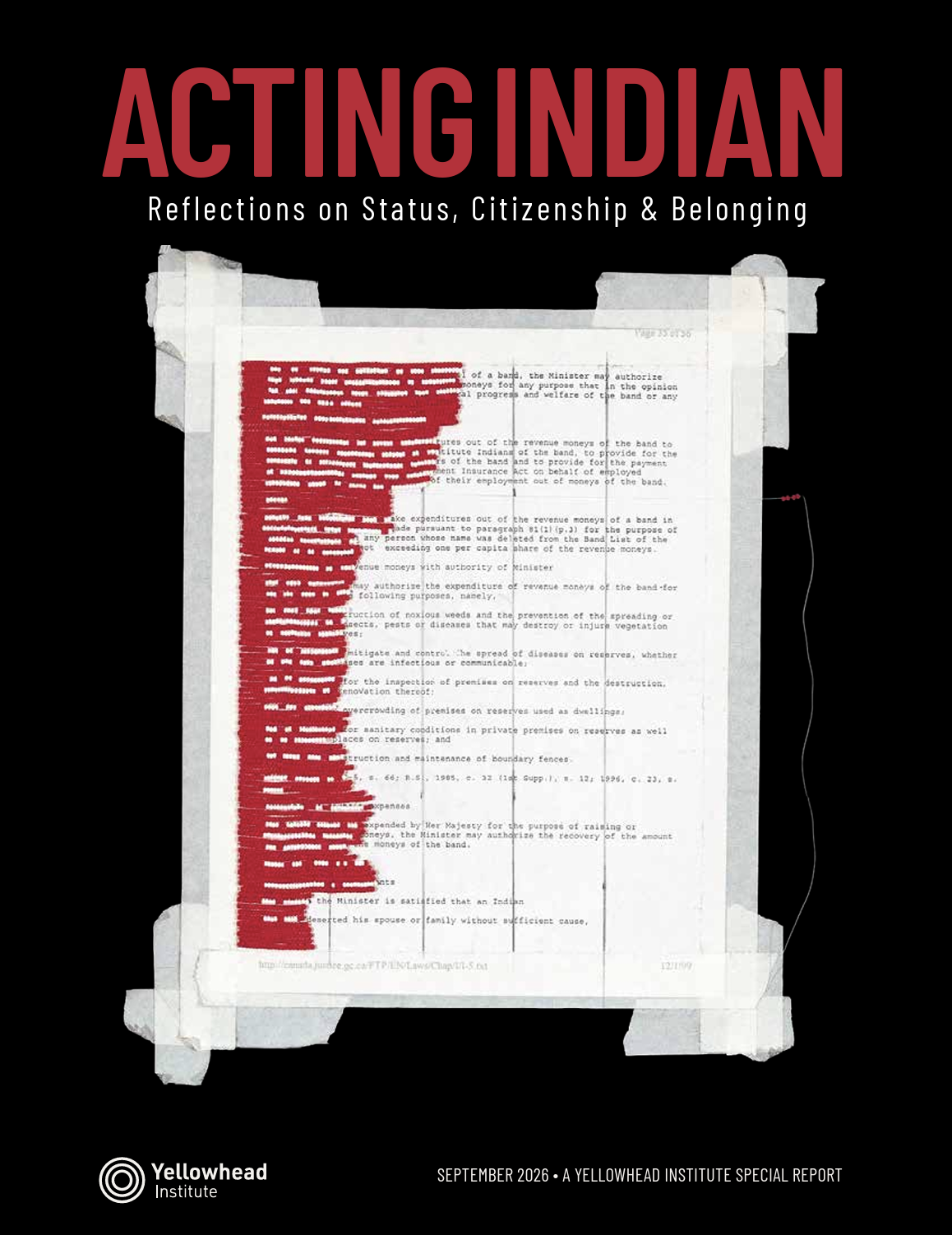
As Canada moves to amend the Indian Act through Bill S-2, Acting Indian: Reflections on Status, Citizenship & Belonging asks how First Nations can reconcile authentic understandings of citizenship with a legislative framework designed to sever kinship systems and replace them with administrative categories.
Bringing together seven First Nation thinkers — Haida, Ts’msyen, St’at’imc, Cree, Anishinaabe, and Mohawk — the report returns, again and again, to a central distinction: status is not belonging, and a registration number is not citizenship.
Jackson Pind traces the coercive history of enfranchisement and its consequences while Christina Gray and Jade Demoulin assess whether legal reform can restore the relationships the Act severed, and Gina Starblanket argues for a return to a
one-parent rule to remedy the discrimination introduced by the 1985 two-parent rule. Turning to community dynamics, Damien Lee cautions against membership codes that reproduce the Act’s exclusions and proposes regional citizenship commissions while Vanessa Watts examines how status has mis-shaped identity verification in post-secondary institutions and Michaela McGuire argues that repair lies not in federal reinstatement but in reviving clan systems, adoption practices, and Nation-based constitutional orders.
In the ongoing debate about S-2, the contributions in this edited volume make the argument that redefining citizenship will only be effective if on Indigenous terms — grounded in reciprocity, relationship, and care.
KEY QUESTIONS
Can our “authentic” understandings of citizenship and belonging be expressed through Canada’s legislative framework?
How will new changes to the Indian Act (S-2) affect communities?
TABLE OF CONTENTS
Editor’s Introduction:
The Hard Work of Belonging
Hayden King
Anishinaabe Encounters with Enfranchisement: Citizenship, Identity, and Colonial Law
Jackson Pind
Bill S-2 and the Indian Act: Relational Ethics of Care
Christina Gray (‘Aɬaxsgaaxsiɬ Gaax Aganɬaak) and Jade Dumoulin
Bill S-2: A Pathway to Relational Repair and Recovery
Gina Starblanket
Section 10 Voting Thresholds: A Distraction from Decolonizing Band Membership
Damien Lee
“Marry Out, Get Out”: The Fait Accompli of Settler Logic in Indigenous Ancestry Verification Times
Vanessa Watts
Beyond the Cage of Indian Status: Nation-Based Approaches to Belonging
Michaela M. McGuire
As the debate provoked by S-2 goes on, there is now a renewed push to breathe life into the project of redefining citizenship on our terms. While the moment is compelled by the courts and government for their own purposes, could there be a path to get this right?
- Hayden King
artist
Nadia Myre
Kitigan Zibi Anishinabeg First Nation
artist
Luanne Redeye
Seneca Nation